


By Patti Loveless, Broker, Cynosure Ventures, LLC · Last updated
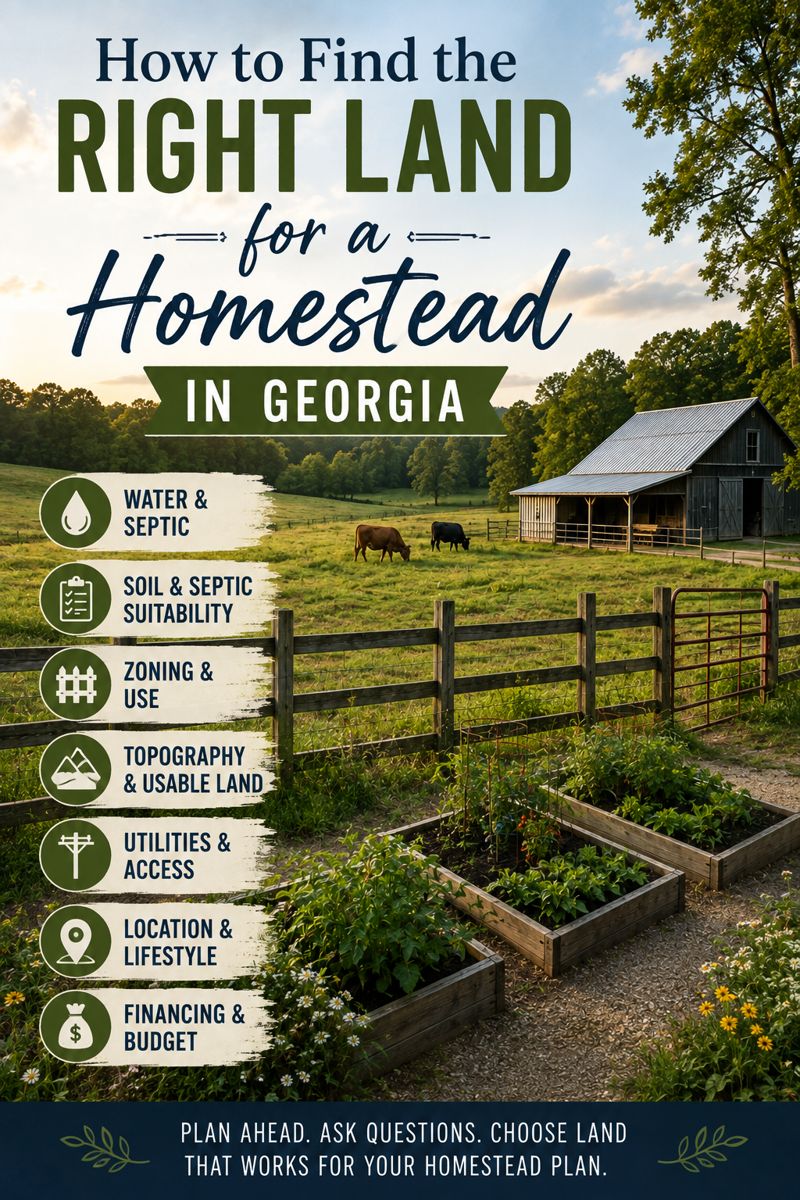
Before buying homestead land in West Georgia, confirm the land can do what you plan: get a current survey, a soil report for septic, a water plan (existing or new well), written zoning approval for your animals and buildings, power access to the homesite, flood-zone status, clear title and mineral rights, and financing lined up before you make an offer.
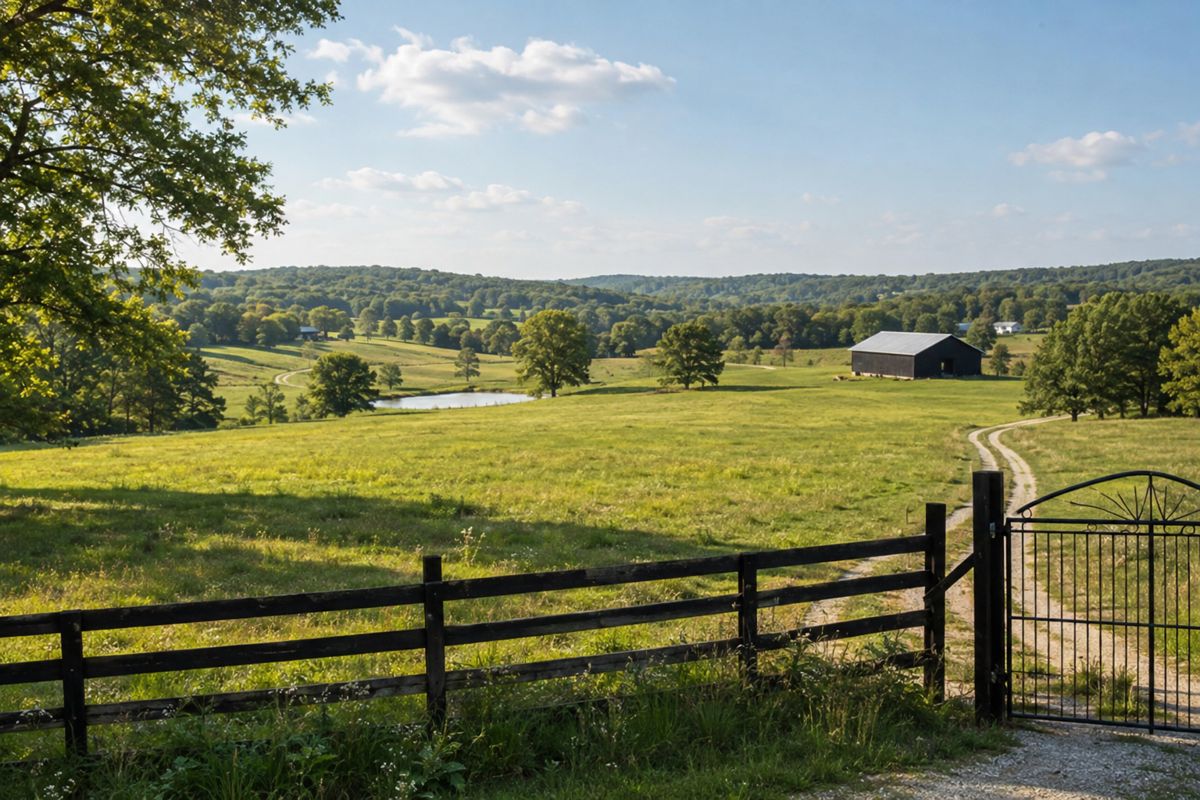
- Price per acre alone is a poor guide. Road frontage, utilities, a well, an approved septic site, pasture and fencing change a tract's value more than its size.
- Rural does not mean "anything goes." Zoning in Paulding, Polk, Carroll and Haralson counties differs, so verify livestock, outbuildings, RVs and second dwellings with the county before you buy.
- Most rural tracts need their own septic system and well. Plan both during your due diligence period, not after closing.
- Land loans work differently from home mortgages. Talk to a land or agricultural lender before you make an offer.
Why does West Georgia work for homesteaders?
West Georgia is one of the areas Patti Loveless recommends to buyers who want acreage, privacy, room to grow food or raise animals, or a more independent way of living. From Dallas and Paulding County to Rockmart and Polk County, Bremen and Haralson County, and throughout Carroll County, buyers can still find rural property with real space that is not cut off from town or the Atlanta metro area.
The land itself is varied. Depending on the tract, you will find rolling hills, creek bottoms, hardwood timber, established pasture and open ground for gardens, orchards, animals and outbuildings. Tracts range from a few acres near established communities to large rural parcels with timber, creeks, ponds and barns.
Location is the other advantage. You can live in the country and still be a reasonable drive from Dallas, Rockmart, Cedartown, Bremen and Carrollton for work, healthcare and shopping.
As Patti likes to say, sunsets hit different out here. There is a quality of life on a quiet piece of West Georgia land at dusk that is hard to appreciate until you have watched the light drop behind the tree line yourself.
Buying homestead land in West Georgia is very different from buying a house in a subdivision, though. A beautiful tract can feel perfect on the first walk and still have problems that affect whether you can build, put in a septic system, find water, keep livestock or use it the way you planned.
How much does acreage cost in West Georgia?
There is no single reliable price per acre for West Georgia land. Larger tracts often sell for less per acre than small parcels, but two tracts of the same size can be worth very different amounts depending on location, road frontage, topography, utilities, timber, water features, improvements and how much of the land is usable.
West Georgia acreage snapshot (as of November 18, 2026)
- About 140 land listings of 5 acres or more were for sale across Paulding, Polk, Carroll and Haralson counties, asking from about $40,000 to $9.5 million.
- About 109 tracts of 5 acres or more sold in those counties over the previous 12 months, with an average asking price of roughly $245,000. Most sold tracts were listed between $55,000 and $975,000.
- About 117 homes on 5 acres or more were for sale in the same four counties, with an average asking price of roughly $791,000.
Source: MLS listing data via the Cynosure Ventures, LLC property search, pulled November 18, 2026. Figures are asking prices, change daily and are rounded. They are a general guide, not an appraisal.
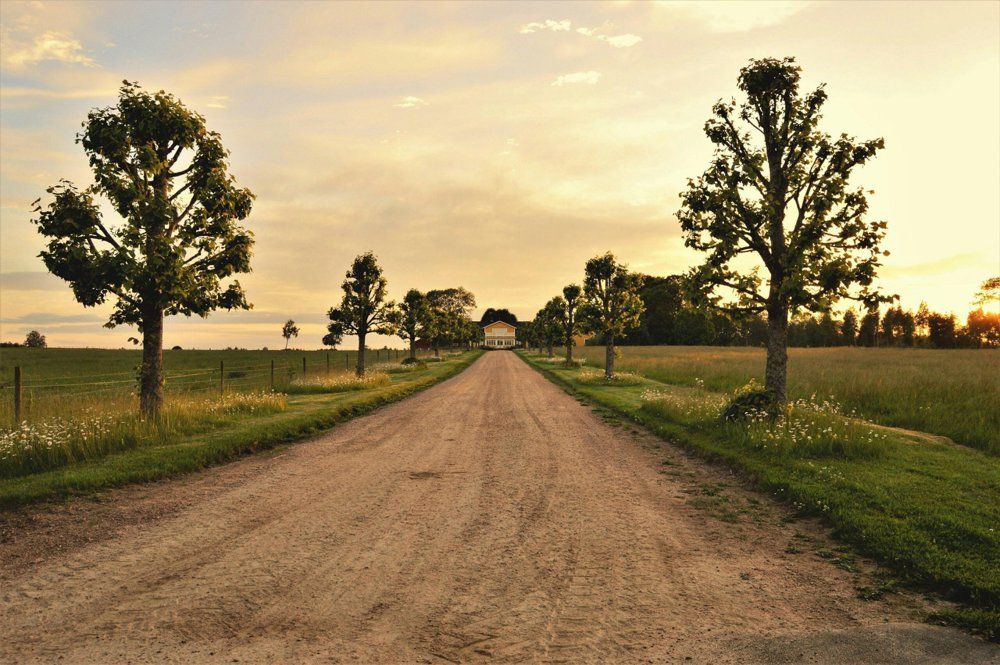
A tract with paved road frontage, an existing well, an approved septic location, established pasture, fencing and a barn may sell for a very different price than raw wooded acreage of the same size with no utilities. When Patti evaluates rural land, these are the features she weighs most:
| Land feature | Why it matters |
|---|---|
| Road frontage and access | Paved frontage and good access can increase usability and resale value. |
| Existing well and septic | Can reduce your upfront development costs. |
| Timber | Mature hardwood or pine can add privacy, recreation and possible timber value. |
| Creek, spring or pond | Desirable for livestock, wildlife and setting, but check for floodplain. |
| Pasture or cleared acreage | Especially valuable if you plan livestock, gardens or a small farm. |
| Topography | Steep ground is usually less usable than gently rolling or level land. |
| Total acreage | Larger tracts often have a lower price per acre, with many exceptions. |
| Utilities | Distance to power, internet and other services can change development costs significantly. |
That is why Patti does not recommend judging a tract by comparing its price per acre with another one nearby. The real question is what you are getting for that price, and whether the land will support what you want to do with it. You can browse current tracts on the Buchanan land for sale and Aragon land for sale pages, or start with the buyer resources page.
What should you check before buying homestead land in West Georgia?
A property can photograph beautifully and check every emotional box. Before you commit, work through these nine practical checks during your due diligence period.
1. Get a current survey
Patti strongly recommends that land buyers consider a current survey. A survey shows the legal boundaries and can reveal easements, encroachments and access problems. Older rural tracts often carry legal descriptions handed down through deeds for decades, and the fence line on the ground is not always the legal line. If you plan fencing, livestock or new buildings, knowing exactly where the property begins and ends matters.
2. Investigate the soil and septic options
Public sewer is rarely available on rural West Georgia acreage, so you need to know whether the land can support an approved onsite septic system. In Georgia, septic systems are regulated by the Georgia Department of Public Health and permitted by the county environmental health office. For a new system, health departments commonly require a soil report from a state-certified soil classifier before they issue a permit.
Do not assume your preferred homesite will pass because the neighbors have houses. Soil, slope, drainage, available space and the location of wells or creeks all matter.
3. Know where your water will come from
If the property already has a well, learn what you can about its condition, location, depth, output and any records. If there is no well, find out what drilling one will involve. A creek or spring is a wonderful feature, but it does not replace an approved source of drinking water. Your water plan belongs in your land evaluation, not on your after-closing to-do list.
4. Verify zoning and your intended use
Never assume "rural" means "anything goes." Zoning and land-use rules differ between Paulding, Haralson, Polk, Carroll and the other West Georgia counties, and they can differ by a parcel's specific zoning class. If your plans include chickens, goats, horses, cattle, several outbuildings, a roadside farm stand, an RV, a manufactured home or a second dwelling, confirm that use with the county planning and zoning department before you buy. Do not rely only on a listing description or on what someone says has always been allowed.
When you buy acreage, you also buy the rules that come with it, so know them before you sign.
5. Check power, internet and cell service
Power lines along the road do not guarantee that electricity can reach your homesite affordably. On a large tract, the distance from the road to the building site can add real cost. Much of this area is served by electric cooperatives, including Carroll EMC, which serves parts of Carroll, Haralson, Paulding, Polk and Floyd counties, and GreyStone Power, which serves parts of Paulding, Douglas, Carroll and Bartow counties. Some properties are served by Georgia Power instead. Call the provider for the specific parcel and ask what extending service will take.
Check internet and cell coverage too. Rural internet has improved, and some cooperatives now offer fiber in parts of their territory, but service still varies from one road to the next.
6. Think carefully about off-grid living
Some buyers looking at homestead land in West Georgia want to live fully or partly off-grid with solar, battery storage, generators, a private well, gardens and livestock. Off-grid does not mean outside the rules. Building codes, septic rules, well rules, zoning and permits still apply. If off-grid living is a priority, tell your agent at the start and confirm the county requirements before you buy. The U.S. Department of Energy's Homeowner's Guide to Going Solar is a useful starting point if solar is part of your plan.
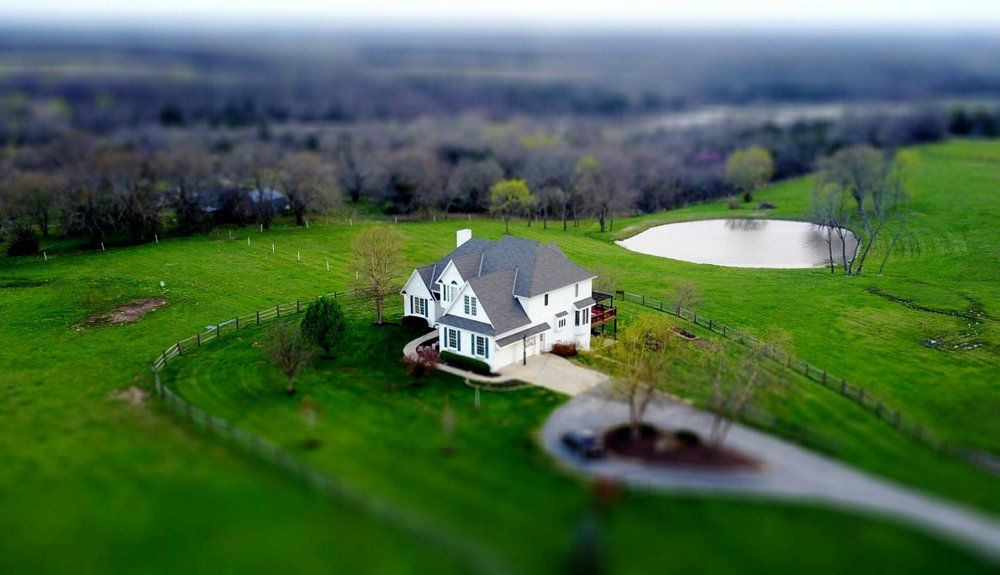
7. Investigate flood zones, drainage and topography
A creek running through a property can be beautiful. It can also mean floodplain. Low areas may stay wet, and steep acreage can look impressive while giving you far less usable land than you expected. Check the parcel on the FEMA Flood Map Service Center, then look at how much of the tract actually works for your house, barn, pasture, garden and driveway.
When she can, Patti walks the land with buyers to see how it lays, where water travels and how practical the homesite will be. Five usable acres can serve a homestead better than twenty acres of difficult terrain.
8. Understand timber and mineral rights
On a larger wooded tract, find out which rights actually transfer with the property. Timber can have real value, and on some tracts it is worth hiring a forester for a timber evaluation. Review the title for mineral rights or other rights that may have been separated from the surface. Your Georgia closing attorney can explain what the title examination shows.
9. Look beyond the land to the improvements
For a homestead buyer, improvements can be worth a great deal. Established fencing, pasture, barns, workshops, a well, a septic system, a driveway, gardens, orchards and equipment storage can save years of work and a lot of money compared with starting from raw land. Patti has seen this repeatedly: a buyer planning livestock will usually value good pasture, fencing, gates and a usable barn far more than a buyer who simply wants a house on a few acres. Your intended use decides whether a tract is a good value.
Take this checklist with you on every land visit
Patti's free West Georgia Homestead & Small Farm Buyer's Guide turns these checks into fill-in pages you can print and carry: a land due diligence checklist, an inspection checklist for the house, barns and fences, a side-by-side property comparison, financing and Georgia farm law basics, and a first-year plan for your land.
Who should you call for each check?
Use this table as a due diligence checklist. Ask your agent to build these items into your contract timeline.
| What to check | Who to contact |
|---|---|
| Boundaries, easements, encroachments | Georgia-licensed land surveyor |
| Septic suitability | County environmental health office and a state-certified soil classifier |
| Well and water quality | Licensed well driller; county environmental health office for water testing |
| Zoning and permitted uses | County planning and zoning department |
| Power to the homesite | The electric provider for that parcel (Carroll EMC, GreyStone Power or Georgia Power) |
| Flood zone | FEMA Flood Map Service Center; county floodplain administrator |
| Title, mineral rights, access | Georgia closing attorney |
| Timber value | Registered forester |
| Land loan options | Local bank, Farm Credit lender or USDA Farm Service Agency |
| Property tax programs | County tax assessor and tax commissioner |
How do you finance homestead land in Georgia?
Financing raw land is different from financing an existing home. Many conventional mortgage programs are not built for vacant acreage. Depending on the property and your plans, options can include local banks, agricultural lenders, land lenders, construction-to-permanent loans and certain government-backed farm programs. Farm Credit and the USDA Farm Service Agency farm loan programs are both worth researching, depending on the property and how you will use it.
Land lenders often weigh acreage, access, improvements, intended use and down payment differently than a home lender does. Talk with the right lender before you start making offers, so you know your options before you are under contract.
What property tax breaks apply to homestead land in Georgia?
Homestead exemption
Once you build or buy a home on the land and make it your primary residence, you may qualify for Georgia's homestead exemption, which lowers the taxable value of your home. According to the Georgia Department of Revenue, applications are filed with your county tax officials, and the deadline for the current tax year is generally April 1. Georgia also has a statewide "floating" homestead exemption, created by HB 581, that limits how fast your home's assessed value can rise each year, although some local governments opted out. Ask the tax commissioner in your county which exemptions apply.
Conservation use (CUVA)
If you plan to farm, grow timber or keep land in conservation use, ask about Georgia's Conservation Use Valuation Assessment, known as CUVA. It taxes qualifying land on its current use value instead of its full market value, in exchange for a 10-year covenant to keep the land in that use. Breaking the covenant early can trigger penalties. Tracts under 10 acres can qualify but need extra proof of bona fide agricultural or timber use. In November 2026, Georgia voters approved a constitutional amendment raising the maximum acreage a single owner can enroll from 2,000 to 4,000 acres. If you are buying land that is already in a CUVA covenant, ask your closing attorney and the county tax assessor how the covenant affects you before you close.
Frequently asked questions about homestead land in West Georgia
How many acres do I need for a homestead in West Georgia?
There is no single right number. A garden, chickens and a few small animals can work on a small, well-laid-out tract if local zoning allows it. Larger livestock, big pastures, several outbuildings, orchards, hunting or more privacy usually call for considerably more land. Start with what you want the property to do, then find the acreage that fits.
Is off-grid living legal in West Georgia?
Many forms of off-grid and self-sufficient living are possible, but the rules vary by county and parcel. Solar power, private wells, gardens and livestock are common on rural land. Zoning, building codes, septic rules and well rules still apply, so verify your plans with the county and state before you buy.
Should I buy raw land or a rural home with acreage?
A rural home with acreage gives you a place to live now and may include a well, septic system, driveway, fencing, pasture and barns. Raw land lets you build exactly what you want, but it adds costs for clearing, grading, a driveway, utilities, a well, septic, permits and construction. Neither is automatically better. The right choice depends on your budget, timeline and goals.
Do I need a survey when buying rural land in Georgia?
A current survey is strongly recommended for rural acreage. It confirms the boundaries and can reveal easements, encroachments and access problems that affect how you use the land. Discuss your situation with your agent and your Georgia closing attorney.
Can a small homestead get lower property taxes in Georgia?
Possibly. Your primary residence may qualify for the homestead exemption if you apply with the county, generally by April 1. Land used for farming or timber may qualify for Conservation Use Valuation Assessment (CUVA) under a 10-year covenant, and tracts under 10 acres must show extra proof of agricultural use. Check with the county tax assessor.
Find the right homestead land with a West Georgia broker
The best piece of land is not always the prettiest one or the one with the lowest price per acre. It is the one that can support the life you are planning. Patti Loveless works with rural homes, land and homesteads across Dallas and Paulding County, Rockmart and Polk County, Bremen and Haralson County, Carroll County and the rest of West Georgia, and she helps buyers look past the listing to the land itself.
Whether you are ready to tour acreage or still deciding what kind of property fits your plans, start with the free buyer's guide or a conversation.
Get the free homestead buyer's guideTalk with Patti about land

Patti Loveless, Broker
Cynosure Ventures, LLC | Guiding Every Move
Licensed since 2014, with 200+ transactions and over $50 million in sales. Patti specializes in land, homes on acreage, homesteads and small farms, and luxury homes across West Georgia.
Brokerage: 770-727-1590 | Cell: 678-910-5217 | Meet the team
Cynosure Ventures, LLC, 1051 Lemon Rd, Temple, GA 30179, 770-727-1590. Equal Housing Opportunity. This article provides general information and is not legal, tax, lending, surveying, engineering, environmental or financial advice. Property conditions, regulations, zoning, permitting requirements and financing options vary. Buyers should verify information for a specific property with the appropriate government authority and qualified professionals.